Will This Statue Fit? Measure Your Display with a Paper Footprint

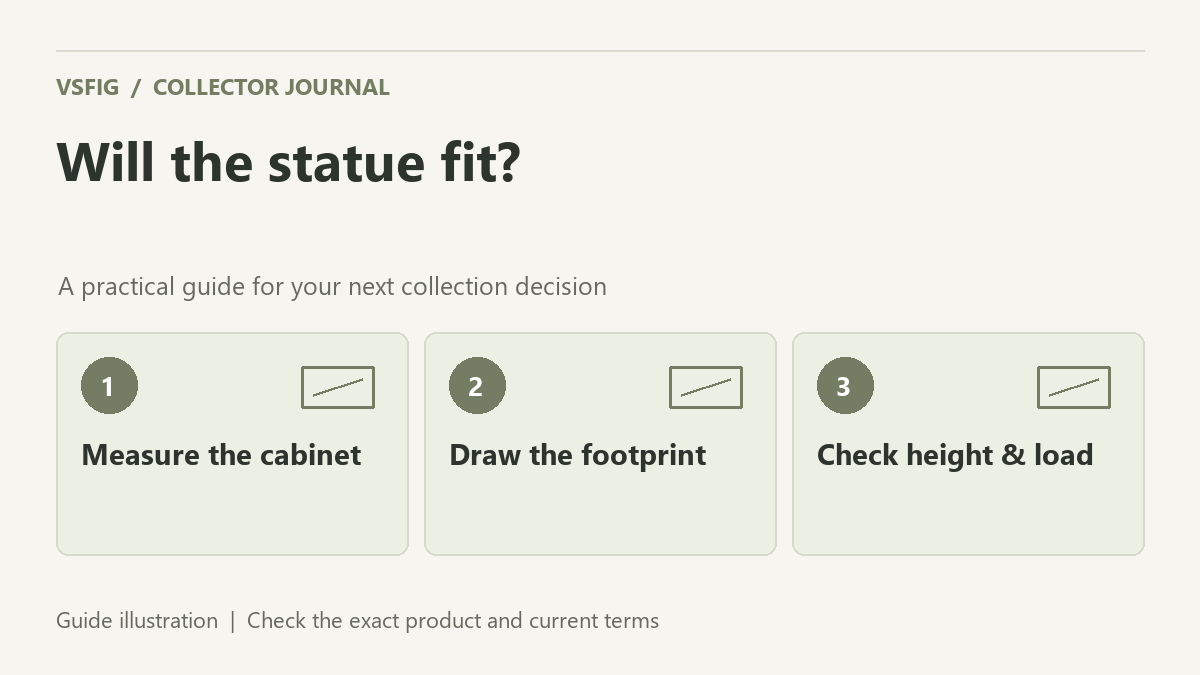
Quick answer: Draw the collectible’s confirmed width and depth on paper, place it in the intended display space, and check the height separately. Include the base and protruding parts. A paper outline tests space; it does not establish whether a shelf can carry the weight.
A dramatic pose can look compact on a product page and surprisingly wide inside a cabinet. Before ordering, a simple paper outline can make the dimensions easier to understand. This is particularly helpful when you are adding a piece beside an existing collection.
Find the complete assembled measurements
Start with the listing’s height, width and depth. Check whether those measurements include the base, effects, raised weapons and alternate display parts. If several editions have different dimensions, use the version you plan to buy.
Do not estimate the footprint from the scale alone. A 1/6 figure with a wide scenic base can need a different space from another 1/6 release. Our scale comparison guide explains why proportions and cabinet measurements answer different questions.
Measure the usable cabinet space
Measure the interior area where the piece would stand. Consider the position of the door, hinges, shelf supports and any lighting equipment. An advertised cabinet width may describe its outside dimensions rather than the clear interior space.
- Usable width: the clear span between obstructions.
- Usable depth: the space available when the door is closed.
- Usable height: the clearance above the intended shelf.
- Access: the opening through which the piece or its parts must pass.
Record these measurements before rearranging your collectibles. Leave practical room for handling rather than planning a display that only fits when everything touches.
Draw and position the paper footprint
Use paper or joined sheets to draw a rectangle matching the confirmed overall width and depth. Label it with the product and edition. If the listing gives only the base size, label your outline “base only” and keep the accessory clearance unconfirmed.
Place the outline on the empty intended shelf, without shifting fragile pieces unnecessarily. It shows how much space the collectible might occupy beside its neighbors. A rectangle based on overall measurements is a planning envelope, not an exact map of every curve in the sculpt.
Check height and access as separate steps
Compare the complete height with the clear space above the shelf. Also consider whether assembly inside the cabinet would be required and whether the supplied instructions allow that approach. The final footprint alone does not tell you whether you can move the piece through the opening.
If an alternate portrait, effect or weapon changes the outline, repeat the check for the arrangement you expect to display. Consult our alternate parts guide when a release has several configurations.
Check the shelf specifications before deciding
Use the cabinet or shelf manufacturer’s stated load information and the collectible’s confirmed weight. Consider the complete display already on that shelf. A paper template cannot test strength, anchoring or stability, and an empty shelf that looks sturdy is not a measurement of its capacity.
When a key specification is missing, ask for it before treating the plan as complete. Our listing checklist provides a message you can adapt. After choosing a suitable space, read the display and care guide.
Worked example: calculate the clear space
Illustrative measurements, not a product specification: suppose the usable cabinet space is 60 cm wide, 40 cm deep and 60 cm high, and the complete collectible measures 45 × 32 × 55 cm.
| Direction | Calculation | Remaining space |
|---|---|---|
| Width | 60 − 45 | 15 cm total |
| Depth | 40 − 32 | 8 cm total |
| Height | 60 − 55 | 5 cm |
This arithmetic only compares dimensions. It does not confirm safe handling room, access through the door, shelf strength or where protruding parts sit. Replace the example numbers with confirmed measurements for your cabinet and selected edition.
Put the guide to use
Compare statue footprints. Choose a listing with confirmed assembled dimensions before drawing your paper footprint. Ask for missing width, depth or weight.
Frequently asked questions
Can I use the shipping carton measurements?
No. Packaging dimensions and assembled display dimensions describe different things. Use the complete collectible’s measurements for the display plan.
What if the piece just fits?
Check door clearance, access and handling room carefully. Ask about any uncertain dimensions before ordering; a close fit leaves little room for assumptions.